
Intel Core 2 Quad Q6600
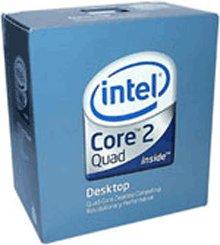
Availability: Phased Out

Pay only P 893 a Month for 12 months.
Or pay only P 1,692 a Month for 6 months.
- Installment promo is available for locally issued credit cards
- Card holder must transact inside an Asianic store to avail of the installment
Features and Benefits:
New power, new speed. Quad-core from Intel.
Leaders of the pack seeking monster performance, look no further. With four
execution cores, the Intel® Core™2 Quad processor blows through
processor-intensive tasks in demanding multitasking environments and makes the
most of highly threaded applications. Whether you're creating multimedia,
annihilating your gaming enemies, or running compute-intensive applications at
one time, new quad-core processing will change the way you do everything.
Pioneer the new world of quad-core and unleash the power of multithreading.
The high end just got higher. Whether it's encoding, rendering, editing,
or streaming, make the most of your professional-grade multimedia applications
with a PC powered by the Intel® Core™2 Quad processor. With four processing
cores and up to 8MB of shared L2 cache¹ and up to 1066 MHz Front Side Bus, more
intensive entertainment and more multitasking can bring a multimedia powerhouse
to your house.
Intel® Wide Dynamic Execution, enabling delivery of more instructions per
clock cycle to improve execution time and energy efficiency.
Intel® Intelligent Power Capability, designed to deliver more
energy-efficient performance and smarter battery performance in your laptop
Intel® Smart Memory Access, improving system performance by optimizing
the use of the available data bandwidth
Intel® Advanced Smart Cache, providing a higher-performance, more
efficient cache subsystem. Optimized for multi-core and dual-core processors
Intel® Advanced Digital Media Boost, accelerating a broad range of
applications, including video, speech and image, photo processing, encryption,
financial, engineering and scientific applications
Make highly threaded applications happy. Get in on the increasing number
of highly threaded programs with quad-core technology from Intel. With four
processing cores, an Intel Core 2 Quad processor-based PC will fuel more
intensive entertainment and more media multitasking than ever.
Comparison Chart:
| Intel® Core™2 Quad Processor Q6700 | Intel® Core™2 Quad Processor Q6600 | |
| Processor Number | Q6700 | Q6600 |
| Architecture | 65 nanometer technology | 65 nanometer technology |
| L2 Cache | 8M | 8M |
| L3 Cache | N/A | N/A |
| Clock Speed | 2.66 GHz | 2.40 GHz |
| Front Side Bus Speed | 1066 MHz | 1066 MHz |
| Package | FC-LGA | FC-LGA |
| Memory Type | NA | NA |
| Slot/Socket Type | LGA775 | LGA775 |
| Pin Count | 775-land | 775-land |
| sSpec Number | SLACQ | SL9UM |
Glossary Definitions
Architecture
The size and spacing of the processor's transistors (silicon etchings), which
partially determine the switching speed. The diameter of transistors is measured
in microns. One micron is one-millionth of a meter. The 90 nm (a nanometer is
one-billionth of a meter) process combines higher-performance, lower-power
transistors, strained silicon, high-speed copper interconnects and a new low-k
dielectric material. For more information see: http://www.intel.com/technology/silicon/nanotechnology.htm
Clock Speed
The speed at which the processor executes instructions. Every processor contains
an internal clock that regulates the rate at which instructions are executed. It
is expressed in Megahertz (MHz), which is 1 million cycles per second or
Gigahertz (GHz), which is 1 billion cycles per second.
Front Side Bus Speed
The speed of the bus that connects the processor to main memory (RAM). As
processors have become faster and faster, the system bus has become one of the
chief bottlenecks in modern PCs. Typical bus speeds are 400 MHz, 533 MHz, 667
MHz, and 800 MHz.
L2 Cache
The size of 2nd level cache. L2 Cache is ultra-fast memory that buffers
information being transferred between the processor and the slower RAM in an
attempt to speed these types of transfers.
L3 Cache
The size of 3rd level cache, typically larger then L2. L3 Cache is
ultra-fast memory that buffers information being transferred between the
processor and the slower RAM in an attempt to speed these types of transfers.
Integrated Level 3 cache provides a faster path to large data sets stored in
cache on the processor. This results in reduced average memory latency and
increased throughput for larger High-end Desktop workloads.
Package
The physical packaging or form factor (size, shape, number and layout of the
pins or contacts) in which the processor is manufactured. There are many
different package types for Intel® processors. See the Processor Package Type
Guide for photos and details.
Slot/Socket Type
A motherboard is designed for a certain range of processors. One of the
determining factors of processor compatibility is the slot or socket connector
soldered onto the board. 242-contact and 330-contact slot connectors were used
for a short time to allow for L2 cache to be packaged close to the processor
die. Processor manufacturing advancements now allow L2 cache to be manufactured
on the same die as the processor, requiring a smaller form-factor processor
packaging. PGA (pin grid array) sockets are more common, flexible, and compact,
but have many variations in the amount of pin connects and pin layouts.
sSpec Number
Also known as specification number. A five character string (SL36W, XL2XL, etc.)
that is printed on the processor, and used to identify the processor. By knowing
the processor's sSpec Number, you can find out the processor's core speed, cache
size and speed, core voltage, maximum operating temperature and so on.